
On a breezy December morning, Gabriel Gatluak Wal, alias Gabuu Myles, a 28-year-old filmmaker, videographer, producer, film director, music video director, and journalist from South Sudan, was eager to narrate his journey to stardom.
Dressed in a black shirt and with a scarf tied around his neck, Wal sat in a serene corner in a hotel in Addis Ababa, as morning light flashed through the window. He jubilantly told his story.
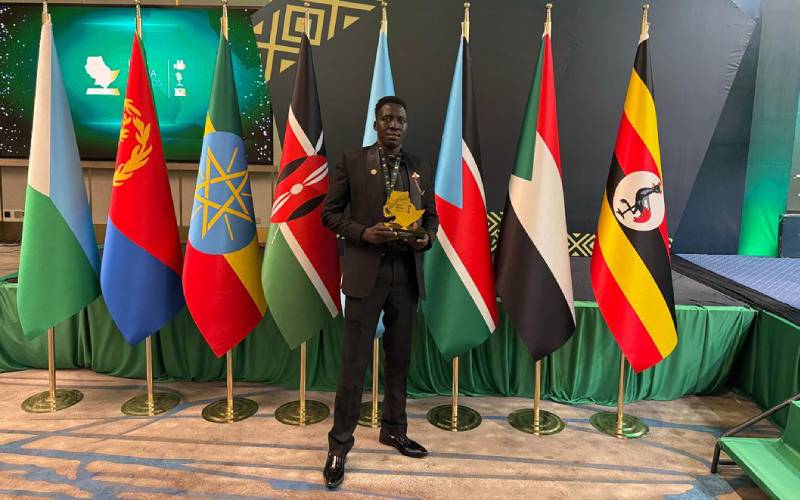
According to the saying, “a journey of a thousand miles begins with a single step,” his documentary “Climate Resilience, Inspiring Hope, Driving Change,” secured the digital category award at the IGAD Media Awards 2025.
Wal’s path to recognition has not been smooth, having faced hardships while living in a refugee camp in Kenya and struggling to make a living in South Sudan, where he operates an unregistered business called G-Wal Studio.
“Currently, G-Wal Studio does not have a head office; we are basically mobile. We have not yet registered as a company, but I have been producing music videos,” he explains with a speck of hope and inspiration.
Like many other creatives, Wal’s rise to success has been fraught with difficulties. His father was killed in 1994 during the liberation struggle. His widowed mother, Nyakuony Gai (now residing in Mayom County, Unity State), raised him and his 14 siblings, while their uncle took on the responsibility of educating them.
“I lost my father in 1994; he was one of the founders of SPLM. He lost his life trying to fight for the country. So, he died a hero. My mother is there. She is called Nyakuony Gai; she is in the village in Mayom County,” he said with a cold face.
Journey of inspiration
In 2010, Wal was living in Kitale, Kenya, where he focused on his studies. Each time, he would notice a motorbike rider carrying a camera and a bag. The Kenyan man would take pictures of people, who could later buy their photos if they found the images appealing. This sparked his inspiration.
“What inspired me to be a producer and to be a journalist, in 2010 when I was staying in Kitale. I used to see a Kenyan guy moving with a motorbike with his camera. He came and took your picture and goes and produces it, and you look at it,” he explains with a smiley face.
Wal also developed a love for movies, a passion that eventually led him to become a producer and filmmaker. By the time South Sudan achieved independence in 2011, he had obtained a camcorder, which was his first camera for capturing the events during the Independence Day celebrations in Kitale that year.
But that was just the beginning. He started taking photos of people purely for fun and later printed them to display on the walls of the event hall. Those who liked their pictures could choose to purchase them, allowing him to earn a little money and sometimes ran at a loss.
In 2013, when war broke out in South Sudan, his uncle lost his job and was unable to pay his school fees. As a result, he moved to Kakuma Refugee Camp in Kenya, where he secured a position with the International Rescue Committee (IRC) as a Community Health Promoter (CHP).
He faced difficulties balancing work and studying in secondary school to finance his education independently. Eventually, he received an opportunity to participate in a film training program (FTP) as a filmmaker with Film Aid in 2015.
He developed an interest in camera work and directing and underwent a rigorous ten months of training before graduating with a diploma. He landed his first full-time job as a cameraman and editor with GIZ.
“So, after joining the film training program, I became interested mostly in camera and directing. So, we were trained for something like ten months. After graduation, in 2017, I was employed by Filmaid as one of their cameramen and editors at the same time. So, from there it became a passion to me, and it became a full-time job,” he narrated his experience.
Wal is now a third-year student at Starford University in Juba, South Sudan, at least to earn a degree from his country.
Stumpy road
Despite the fact that winning the IGAD Media Awards 2025 is a commendable achievement, several challenges lie ahead for him at present. One of such challenges is the lack of a registered media company, despite having created content for nine years since 2016.
“When you try to calculate the years, I am sure if they are less, they might be more than 10 years. So this is, we have been having the experience, we have everything, the problem is, you know, in South Sudan, when you don’t have connection, your things tend to move slowly,” he stressed.
According to Wal, creators who lack connections struggle to find employment, as large companies tend to hire foreigners whom they perceive as more qualified than South Sudanese.
As a South Sudanese creator, one of the significant hurdles Wal currently encounters includes content monetisation. For example, he produces and uploads videos on platforms like YouTube, Facebook, and TikTok, yet he does not receive any payment, as South Sudan lacks an agreement with these social media platforms.
“You are putting your content out there. But because you are not monetised, you cannot get your monthly payment because of monetisation. We have been putting our videos and people are watching them, but you can’t make your money, you can’t get your payment out of it,” he stated.
Going Forward
According to Wal, the government needs to give the entertainment sector top priority as a source of revenue and a profession on par with those of pilots, physicians, teachers, and other professionals.
He contends that filmmakers are frequently confused with journalists, which hinders the growth of the film industry in South Sudan. Wal emphasised the necessity of content monetisation because taxing all revenue from social media content monetisation will help the government generate revenue.
“In South Sudan, we need to have a film industry, and for us to have a film industry, we must work on the monetisation. Imagine if we have almost 1000 content creators, and the government is taking taxes from each individual, how much is that a month? So, that’s what I am seeing,” said Wal in a daring voice.
He urges South Sudanese to compete without fear, pointing out that while Kenya led with seven winners at the IGAD Media Awards 2025, other nations had more winners, and he was the only South Sudanese winner.
He said that he would keep putting in a lot of effort to present South Sudan's story in order to rectify the perception that he claimed had been distorted by false or misleading information. He contends that propaganda is being transmitted by social media users and community journalists, making the media seemingly untrustworthy in South Sudan.
“Most of social media platforms, more especially those which have been owned by individuals or community journalists, intend to have a lot of followers, and you know people love propaganda. People love something that has been manipulated because it looks juicier than the fact,” said Gatluak.
In order to promote Africa's regional integration, he urged IGAD to establish an IGAD Media where all participants and winners might find employment.
“So, I was thinking that IGAD is doing a great job by ensuring that it gives a platform to journalists. Let them also create something like IGAD Media, whereby every winner or every person who has been participating in this can also get an employment opportunity,” Wal requested.
He exhorted African journalists to try to change the story of Africa. Additionally, he exhorted South Sudanese to work together to address the nation's problems in order to accelerate progress that will benefit future generations.